

Invasive mosquito species – new mosquitoes in Europe
Mosquitoes have existed in Europe for thousands of years, but in recent decades several new invasive mosquito species have begun to spread in the region. These species originally lived in other parts of the world but have established themselves in Europe through international trade, transportation, and climate change.
Many of these mosquitoes differ from the species traditionally found in the Nordic region. They may have different behaviors, different habitats, and in some cases even the ability to spread diseases that have not previously occurred in Europe.
In this guide we cover:
- what invasive mosquito species are
- how they spread
- which species are most common in Europe
- what risks they may pose
- how researchers and authorities monitor them
Products preventing Invasive Mosquito Species
-

Mosquito trap Tropic species - Predator Dynamic
Predator Dynamic mosquito hunter with scent that attracts tropical mosquitoes. A mosquito trap that reduces the tropical mosquito population.
PRE-DYN-RED-PAK
9 795 kr / pc.Free shippingAdd to favorites- Stock status
- In stock
-
Insect Catcher Moel AIT 368G
Affordable, safe and effective mosquito and fly trap for indoor use. The UV lamp attracts mosquitoes, flies and insects within 150m².
AIT-368-G
1 095 kr / pc.Add to favorites- Stock status
- In stock
-
Smidge Insect Repellent
Smidge provides effective protection against mosquitoes, midges and other biting insects for up to 8 hours.
SMIDGE-INSEKTSMEDEL
99 kr / pc.149 kr / pc.Save 34 %Add to favorites- Stock status
- In stock
-
Thermacell MR450 Armored Portable Mosquito Repeller
Thermacell MR450 with a smart zone indicator that shows you when the mosquito protection is optimal. Belt clip which makes it easy to carry.
MR450
599 kr / pc.Add to favorites- Stock status
- In stock
-
AMT-200 with CO2 Boosterkit
AMT-200 with mosquito trap with extra CO2 Boosterkit. The trap attracts mosquitoes and midges with heat, light, scent and CO2.
AMT-200-Boosterkit
2 299 kr / pc.Package priceAdd to favorites- Stock status
- In stock
-
Mosquito jacket
Wiggler Mosquito jacket, fine-mesh net jacket that protects against gnats, midges, mosquitoes and moose flies
WIG-MYGGJACKA-S
209 kr / pc.279 kr / pc.Save 25 %Add to favorites- Stock status
- In stock


What is an invasive mosquito species?
An invasive species is a species introduced into an area where it did not previously exist naturally and then begins to spread and establish populations.
Regarding mosquitoes, this often means the species:
- is transported to new areas by humans
- can survive the climate in the new area
- finds suitable places to lay eggs
- starts reproducing locally
Many invasive mosquito species belong to the genus Aedes, which also includes several species known to be capable of spreading viruses between humans.
This does not mean all invasive mosquitoes spread diseases, but some species have the biological capacity to do so under the right conditions.
How do invasive mosquito species spread?
The spread of invasive mosquito species almost always occurs through human activity. Mosquitoes can travel long distances via various types of transport and goods.
The most common pathways are:
International trade
Eggs from certain mosquito species can survive for a long time in dry environments. This allows them to be transported in, for example:
- car tires
- containers
- plant transports
- bamboo or ornamental plants
When the eggs then come into contact with water, they can hatch.
Transport and travel
Mosquitoes can also hitch a ride in:
- trucks
- ships
- airplanes
- tourist trips
This allows species to be quickly moved between different countries.
Climate change
A warmer climate enables some species to have better survival chances in Europe.
Temperature, precipitation, and longer summers can create conditions that allow new species to establish further north than previously.
What risks do invasive mosquito species pose?
Most invasive mosquitoes mainly cause increased irritation and more bites.
But some species can also have medical significance as they can act as vectors, meaning carriers of viruses.
The risks depend on several factors:
- whether the virus is present in the area
- how many mosquitoes there are
- how often people get bitten
In Europe, local outbreaks of diseases such as dengue and chikungunya have occasionally been seen in areas where the tiger mosquito has established.
The risk of major disease outbreaks in northern Europe is currently very low.
This is partly due to:
- the climate
- limited establishment of relevant mosquito species
- effective surveillance systems
However, researchers closely monitor developments since climate and global trade can change the situation over time.
Common invasive mosquito species in Europe
Several species have established themselves in Europe over the last decades. The best known are:
- Asian tiger mosquito (Aedes albopictus)
- yellow fever mosquito (Aedes aegypti)
- Japanese bush mosquito (Aedes japonicus)
- Korean bush mosquito (Aedes koreicus)
Another mosquito different from the common forest mosquito is the so-called subway mosquito, often called the London Underground mosquito (Culex pipiens f. molestus). It is not considered an invasive species but is still interesting as it is cold-intolerant and has adapted to living in urban environments.
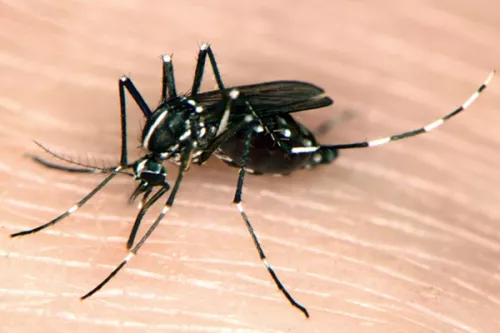
Asian tiger mosquito - Aedes albopictus
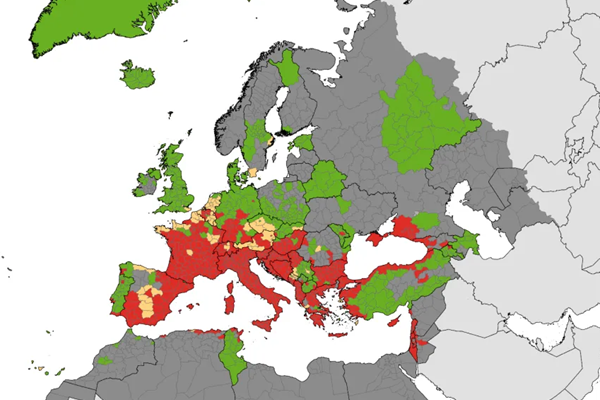
Aedes albopictus, also called the Asian tiger mosquito, is an invasive mosquito species from Southeast Asia. It is easily recognized by its black and white stripes on the body and legs. Over the past decades, the species has spread rapidly worldwide and established itself in many European countries. It is highly adaptable and can develop in small water accumulations in urban environments. The tiger mosquito is active during the day and is considered one of the most important invasive mosquito species in Europe.
Aedes albopictus facts
- Scientific name: Aedes albopictus
- Common name: Asian tiger mosquito
- Origin: Southeast Asia
- Presence in Europe: see image, June 2025
- First findings in Europe: 1970s
- Spread: international trade, especially car tires
- Activity: mainly daytime
- Habitat: cities, gardens, and parks
- Eggs laid in: small water containers
- Can spread viruses: dengue, chikungunya, zika
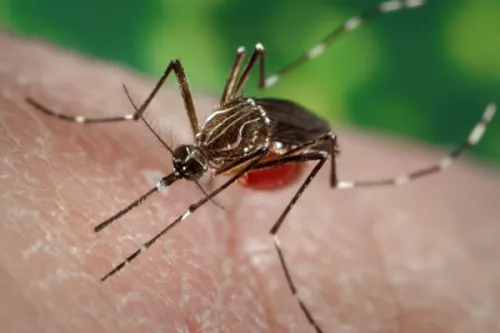
Yellow fever mosquito (Aedes aegypti)
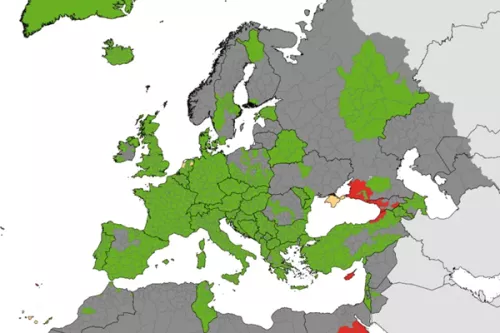
Aedes aegypti, often called the dengue or yellow fever mosquito, is a tropical mosquito species that mainly lives close to humans. It originally comes from Africa but has spread to large parts of the world through trade and transport. The species thrives in urban environments where it lays eggs in small water accumulations such as containers, barrels, and flowerpots. In Europe, it mainly occurs in warmer regions around the Mediterranean and is closely monitored because it can act as a carrier of several viral diseases.
Aedes aegypti facts
- Origin: Africa
- Scientific name: Aedes aegypti
- Common names: dengue mosquito, yellow fever mosquito
- Presence in Europe: see image, June 2025
- Thrives in: urban environments near humans
- Eggs laid in: small water accumulations
- Activity: mainly daytime
- Can spread: dengue, zika, chikungunya
- Spread: trade and transport
- Monitored by: European health authorities
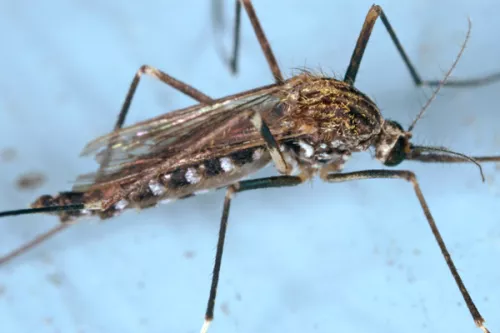
Japanese bush mosquito - Aedes japonicus
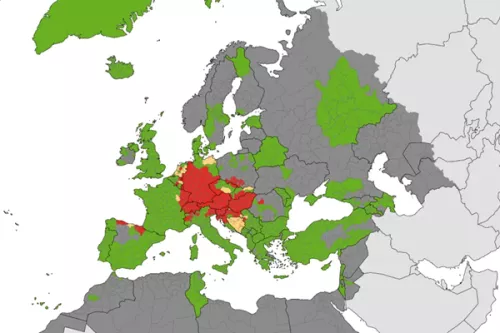
Aedes japonicus, often called the Japanese bush mosquito, is an invasive mosquito species originally from East Asia. It was discovered in Europe in the early 2000s and has since spread to several countries. The species thrives both in forest and urban environments and can develop in small water accumulations such as barrels, ponds, and containers. It is relatively tolerant to cooler temperatures, which allows it to establish itself further north in Europe than many other invasive mosquito species.
Aedes japonicus facts
- Origin: East Asia
- Scientific name: Aedes japonicus
- Common name: Japanese bush mosquito
- First findings in Europe: approx. 2000
- Presence: see image, October 2023
- Tolerates: cooler climate
- Habitat: forest and city
- Eggs laid in: water-filled containers
- Activity: mainly daytime
- Monitored by: researchers and authorities
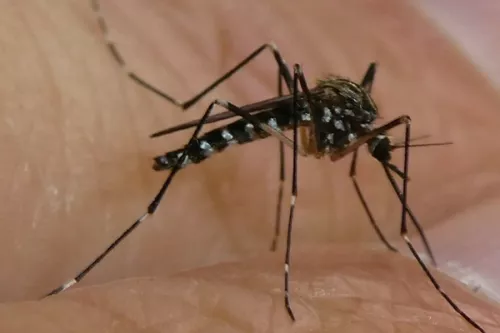
Korean bush mosquito - Aedes koreicus
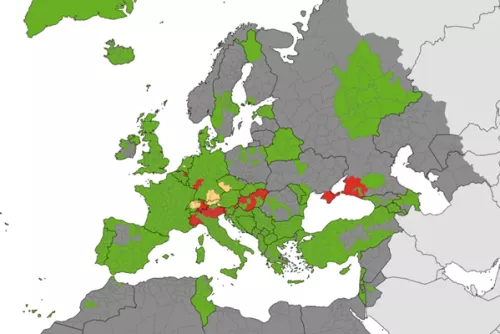
Aedes koreicus, or Korean bush mosquito, is an invasive mosquito species from East Asia that has been found in several European countries in recent years. The species somewhat resembles the Asian tiger mosquito but may be better adapted to cooler temperatures. It can live both in urban environments and more natural habitats and often develops in small water accumulations. Due to its adaptability, the species is closely monitored by researchers in Europe.
Aedes koreicus facts
- Origin: Korea and East Asia
- Scientific name: Aedes koreicus
- Common name: Korean bush mosquito
- First findings in Europe: around 2008
- Presence: see image, October 2023
- Tolerates: cooler climate
- Habitat: city and nature
- Eggs laid in: small water accumulations
- Activity: mainly daytime
- Monitoring: European research programs
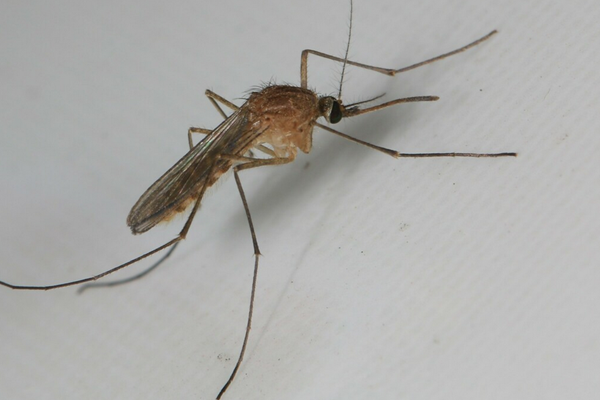
London underground mosquito (Culex pipiens molestus).
London underground mosquito (Culex pipiens molestus) is a distinct form of the house mosquito Culex pipiens that has adapted to living in urban environments, often underground. It became known after being discovered in the London subway system, where it could survive in warm and humid tunnels. Unlike many other mosquito species, the underground mosquito can be active year-round and does not need to hibernate during winter. It often lives in basements, tunnels, sewer systems, and other underground environments where there is still water.
Culex pipiens molestus Facts
- Scientific name: Culex pipiens f. molestus
- Group: form of house mosquito (Culex pipiens)
- Origin: developed in urban environments
- Known from: London underground
- Presence: several European major cities
- Habitat: tunnels, basements, sewer systems
- Activity: year-round
- Bites mainly: humans
- Reproduction: can occur in enclosed spaces
- Nickname: sometimes called “super mosquito” in media
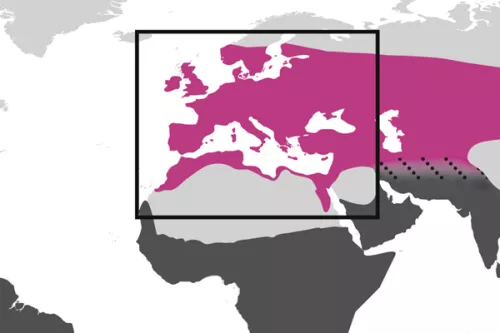
Sammanfattning
Invasiva myggarter är myggor som spridits till nya delar av världen genom mänsklig aktivitet. Flera sådana arter har under de senaste decennierna etablerat sig i Europa.
Den mest kända är den asiatiska tigermyggan, men även arter som japansk buskmygga och koreansk buskmygga förekommer i regionen.
Även om vissa arter kan sprida virus är risken för större sjukdomsutbrott i norra Europa fortfarande låg. Samtidigt följer forskare utvecklingen noggrant eftersom klimatförändringar och global handel kan påverka spridningen i framtiden.
Genom övervakning, forskning och förebyggande åtgärder går det att bättre förstå och hantera dessa nya myggarter.